America's Electoral Paradox: What happens when different demographics take over the ballot box?
An election is not merely a contest between political parties. It is a contest between competing demographic realities. Change the composition of the electorate, and the political map of an entire nation can change.
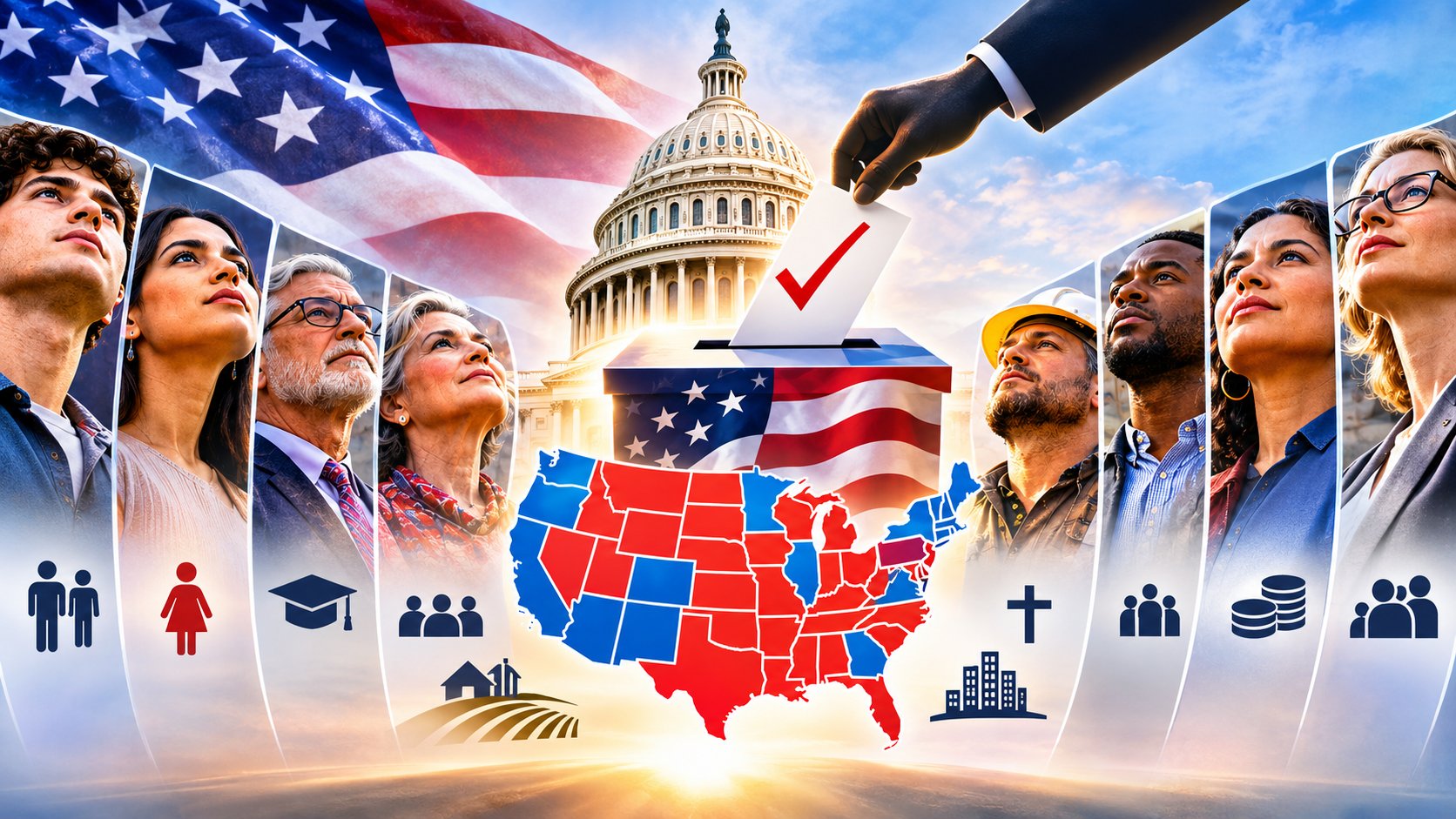
What if America's electoral map were determined not by the electorate as a whole, but exclusively by particular demographic groups? What if only senior citizens voted? What if the electorate consisted entirely of voters under 30? What if only white Americans without college degrees, wealthy Americans, Latino voters or Black voters participated in the election? Would America still look politically the same? An interesting series of electoral visualisations shared by the Dear Data Instagram page, which regularly explores elections through demographic and data-driven perspectives, offers a fascinating way of examining these questions ahead of the 2026 US midterm elections. The exercise is particularly revealing because it demonstrates how dramatically electoral outcomes could change depending on the age, educational qualifications, income and racial composition of the voting population. The underlying message is simple but profound: electoral outcomes are not determined merely by how many people support a political party. They are also determined by which sections of society actually turn up to vote.
The age divide offers perhaps the most fascinating starting point. Consider the scenario in which only voters aged 45 to 64 participate. The resulting electoral map displays a distinct political configuration, with several states leaning towards the Republican side. When the electorate is restricted to senior citizens, the political distribution changes, although some areas of continuity remain. However, the picture becomes considerably more striking when only voters under 30 are allowed to determine the outcome. The resulting map turns overwhelmingly blue, suggesting a substantial Democratic advantage across the country. The contrast illustrates the growing generational divide in American politics. Younger Americans often approach questions of employment, student debt, housing affordability, climate change, reproductive rights and social inclusion differently from older generations. Their political expectations and economic anxieties are not necessarily aligned with those of their parents or grandparents. Yet there is a fundamental contradiction: a generation that can dominate political conversations, social media platforms and public debates may not necessarily exercise equivalent influence at the ballot box. Numerical strength does not automatically translate into political power. Participation is what converts demographic strength into electoral influence.
The educational divide produces another striking contrast. When the electoral map is restricted to white voters without college degrees, the Republican advantage becomes particularly pronounced, with much of the country turning red. However, when the electorate consists exclusively of white college graduates, the picture changes dramatically. The resulting map is considerably bluer, with Democratic strength extending across numerous states that appeared Republican in the previous scenario. This contrast illustrates how educational background has become an important political dividing line in American society. Educational qualifications are not merely indicators of academic achievement; they often intersect with occupation, income, geographical location, cultural outlook and attitudes towards public policy. White voters without college degrees have emerged as an important constituency in Republican electoral calculations, while college-educated voters, particularly in metropolitan and suburban communities, have become an important component of the Democratic coalition. What makes this comparison particularly interesting is that even within the same racial category, educational background can produce substantially different electoral preferences. It challenges the assumption that race alone determines voting behaviour and demonstrates the complexity of political identities in contemporary America.
The economic dimension adds another layer to this analysis. The scenario involving Americans earning more than $100,000 annually produces yet another electoral configuration, with several states changing political colours compared with other demographic scenarios. The map suggests that higher-income voters constitute a distinct electoral constituency whose preferences can significantly influence the political landscape. Their voting decisions may be shaped by taxation, business regulation, economic growth, investment climate, financial markets and government spending. However, wealth does not automatically translate into a particular political preference. High-income Americans are not a politically homogeneous group, and their priorities can differ depending on their professions, geography, social outlook and economic interests. Nevertheless, the exercise makes an important point: political parties cannot assume that voters belonging to different economic classes will necessarily respond to the same political messaging. Economic identity and political identity intersect in complicated ways, and successful electoral strategies must recognise these differences.
The Latino voter scenario is equally revealing. The resulting map is predominantly blue, with only a limited number of states displaying Republican strength. Latino voters have become an increasingly consequential constituency in American politics, particularly in states where their numbers can influence electoral outcomes. However, treating Latino Americans as a single political bloc would be a mistake. Their preferences vary according to national origin, geography, generation, religion, employment, economic circumstances and views on immigration. Their political importance lies not simply in their growing numbers but also in their geographical concentration and participation in elections. For Democrats, retaining support among Latino voters remains important, while Republicans see opportunities to expand their appeal within this constituency. The competition for Latino support will therefore remain a significant feature of American electoral politics. The broader lesson is that demographic groups should never be treated as permanently belonging to one political party. Their preferences can evolve, and political parties must continually engage with their concerns.
The Black voter scenario presents perhaps the most striking visual outcome of the entire exercise. The map turns entirely blue, reflecting the historically strong association between Black voters and the Democratic Party. This political alignment has deep historical roots, shaped by the civil rights movement, the struggle for racial equality, voting rights and debates surrounding economic opportunity and access to public services. Black voters have consistently constituted an important Democratic constituency, particularly in states where their participation can influence closely contested electoral outcomes. Yet political loyalty should never be mistaken for political complacency. No constituency can be taken for granted indefinitely. Parties must continue to engage with voters, understand their changing expectations and demonstrate that electoral promises translate into meaningful outcomes. The political significance of Black voters is not simply that they form a dependable electoral base, but that their participation can become decisive in determining the outcome of elections.
Taken together, these demographic visualisations offer a fascinating perspective on the political composition of the United States. The same country produces dramatically different electoral maps depending on whether the electorate consists of younger voters, senior citizens, middle-aged Americans, college graduates, non-graduates, high-income earners, Latino voters or Black voters. The conventional classification of America into red states and blue states therefore tells only part of the story. Political parties do not win national elections by appealing to one demographic group alone. They succeed by building coalitions across different sections of society. The Republican Party's strength among certain working-class, older and non-college-educated constituencies contrasts with Democratic strength among younger, college-educated and several minority constituencies. These are broad electoral tendencies rather than universal rules, and individual voting behaviour can differ considerably. A young Latino college graduate earning more than $100,000, for instance, belongs to several of the demographic categories examined in these visualisations. This overlap is precisely why electoral analysis requires more than simply looking at individual demographic groups in isolation.
There is also a crucial distinction between political preference and actual electoral participation. A demographic group may have considerable numerical strength, but if its members do not vote in sufficient numbers, its political influence remains limited. Younger Americans may represent a significant constituency, but their electoral impact depends on turnout. Senior citizens often exercise considerable influence because of comparatively consistent participation. Minority communities can become decisive when political mobilisation translates into votes. For political strategists, therefore, understanding who supports a party is only one part of the exercise. They must also understand who is likely to vote, where those voters are concentrated, what motivates them and what issues could persuade undecided sections of the electorate. Electoral victories are built through the combination of persuasion, mobilisation and coalition-building.
The Dear Data Instagram analysis should be understood for what it is: a series of hypothetical demographic voting scenarios, not a prediction of the actual outcome of the 2026 midterm elections. Isolating individual population groups helps reveal their potential electoral influence, but it does not mean that these groups vote uniformly or independently in real elections. Nevertheless, the visualisations succeed in raising a fundamental question about the nature of American democracy. If different sections of the American population could independently determine the country's political future, would they choose the same America? The maps suggest otherwise. An electorate dominated by younger voters produces a very different political picture from one dominated by senior citizens. The same is true of educational qualifications, income and racial demographics.
Ultimately, the most important lesson is that America does not have just one electoral map. It has several political Americas existing within the same geographical boundaries, each with its own priorities, expectations and political preferences. The ballot box brings these competing realities together and produces a single electoral outcome. A nation may have one election, but the people participating in it are voting for very different versions of its future. That is the real paradox of American democracy.
More from Beyond Dakshin

Sai Pallavi cuts her hair for ‘OM’, takes inspiration from IPS officer Merin Joseph; mother reacts in shock

Mahesh Babu–Rajamouli’s ‘Varanasi’ eyes record ₹290 crore Telugu States deal, set to surpass ‘RRR’

Allu Arjun lines up mythological pan-India spectacle with Boyapati Sreenu after ‘Raaka’!
More from Politics

Padma Shri Dr B. Raman Rao enters Guinness World Records for treating over 33 lakh patients over 2777 Sundays

Rahul Gandhi calls for rethinking democracy and economic models amid growing influence of tech giants