‘Andhra’s Deception’: New Telugu daily "Prabhata Udayam" opens with explosive report on Krishna waters
Inaugural edition alleges a covert attempt to divert Nagarjuna Sagar waters to Andhra Pradesh; raises questions over Telangana government's vigilance and signals an assertive editorial approach towards inter-state water disputes
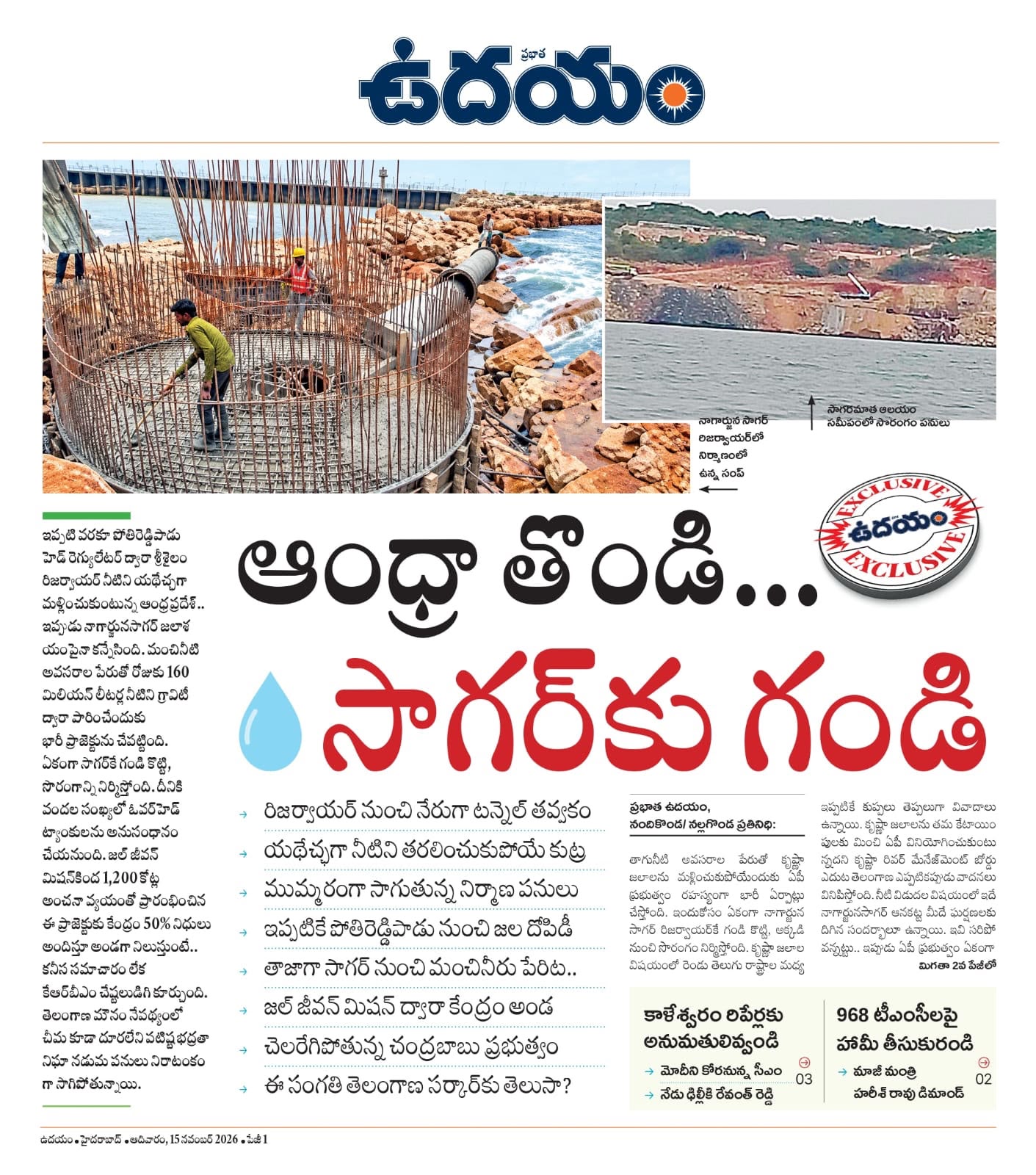
The newly launched Telugu daily Prabhata Udayam has made a politically significant debut, choosing one of Telangana's most sensitive issues — the sharing of Krishna River waters with Andhra Pradesh — as the lead story of its inaugural edition.
With the provocative headline “ఆంధ్రా తొండి... సాగర్కు గండి” (Andhra's Deception, a Breach in Sagar), the newspaper alleges that construction activities are underway to divert water from the Nagarjuna Sagar project towards Andhra Pradesh, potentially threatening Telangana's irrigation interests.
The report is significant not merely because of the allegations it makes, but also because of the questions it raises about inter-state water management, the role of irrigation authorities and the Telangana government's responsibility to safeguard the state's water entitlements.
The newspaper's front-page report focuses on alleged construction activity near the Nagarjuna Sagar project, including work associated with a tunnel or water-diversion infrastructure.
The accompanying photographs show construction activity involving steel reinforcement and concrete structures near a waterbody, along with an image of an excavated hillside. However, the photographs alone do not establish the precise location, purpose, authorisation or eventual use of the structures.
The report suggests that the works could facilitate the movement of water towards Andhra Pradesh and questions whether the activity is being undertaken with adequate transparency and oversight.
These allegations, if substantiated, could have implications for Telangana's irrigation requirements, particularly in areas dependent on Krishna River water allocations.
The newspaper also raises the broader question of whether Telangana's irrigation authorities are sufficiently monitoring developments around infrastructure shared with Andhra Pradesh.
The Nagarjuna Sagar project, built across the Krishna River, occupies a particularly sensitive position in the relationship between Telangana and Andhra Pradesh. The dam and its associated irrigation infrastructure serve areas in both states, making water allocation and operational control recurring sources of disagreement.
Following the bifurcation of Andhra Pradesh in June 2014, the management of Krishna River waters became one of the most contentious unresolved issues between the successor states.
Telangana has repeatedly emphasised the need to protect its irrigation requirements and secure what it considers a fair share of Krishna waters. Andhra Pradesh, meanwhile, has defended its own irrigation and drinking-water requirements, particularly in areas dependent on existing Krishna basin projects.
The Krishna River Management Board and other statutory and inter-state mechanisms have roles in managing these disputes, but disagreements over water releases, infrastructure and operational authority have continued.
Against this background, allegations of new infrastructure intended to divert water from Nagarjuna Sagar carry considerable political significance, irrespective of whether the specific claims made by Prabhata Udayam are ultimately established.
One of the most striking claims in Prabhata Udayam's report is that Andhra Pradesh is attempting to divert 160 million litres of water per day from the Nagarjuna Sagar reservoir to meet drinking-water requirements.
According to the newspaper, the proposed diversion is connected to infrastructure being developed through the Jal Jeevan Mission. The report refers to a project with an estimated expenditure of ₹1,200 crore and alleges that the Union government is providing 50% of the funding.
The newspaper claims that a tunnel is being excavated directly from the reservoir, rather than drawing water through an existing head regulator. It describes the proposed arrangement as an attempt to extract water through a separate route.
Another allegation concerns the speed of construction. The report claims that work is proceeding rapidly, including round-the-clock construction activity, and suggests that the project could be completed before Telangana authorities intervene.
The front-page highlights also refer to the use of a tunnel-boring machine and question whether the Telangana government has been adequately informed about the construction.
The report further alleges that officials have been reluctant to provide clear information about the works and that Andhra Pradesh is moving ahead with the project despite unresolved inter-state concerns.
These are allegations reported by the newspaper, not independently established findings. The precise alignment of the tunnel, its intended withdrawal capacity, the applicable approvals and the legal status of the project require documentary verification.
The political implications of the report extend beyond Andhra Pradesh.
By questioning whether the Telangana government is aware of the construction, Prabhata Udayam effectively places the Congress administration under scrutiny.
The report raises an important issue: if construction affecting a shared water resource is taking place, what information has been provided to Telangana's irrigation department, and what measures are being taken to protect the state's interests?
The newspaper's approach is especially noteworthy because Krishna River water sharing has historically been a politically charged subject in Telangana. Any suggestion that Andhra Pradesh is gaining an advantage at Telangana's expense could generate controversy among political parties, farmers' organisations and irrigation experts.
The editorial significance of the inaugural edition is difficult to overlook.
Rather than opening with a ceremonial announcement or a conventional political story, Prabhata Udayam has chosen a potentially contentious investigation involving Andhra Pradesh, Telangana and the Union government's funding of water infrastructure.
Its headline, presentation and pointed questions indicate an intention to attract attention through hard-hitting reporting.
The selection of this story may also provide an early indication of the newspaper's future approach towards the Congress government in Telangana. By placing the protection of Telangana's water resources at the centre of its coverage, the publication appears prepared to challenge the government on issues that carry considerable regional and political sensitivity.
At the same time, it would be premature to conclude that the newspaper has adopted a particular political alignment. Its coverage of subsequent controversies, including issues involving opposition parties, will offer a clearer indication of its editorial independence.
For now, the inaugural edition has achieved something important for a new publication: it has introduced a potentially consequential public-interest issue and placed questions before the governments concerned.
The immediate test is whether the allegations lead to official disclosures, technical clarification and a transparent assessment of the proposed water-diversion infrastructure.
The longer-term test for Prabhata Udayam will be whether it can sustain this investigative approach with documentary evidence, balanced reporting and consistent scrutiny of those in power.
More from Telangana
More from Politics
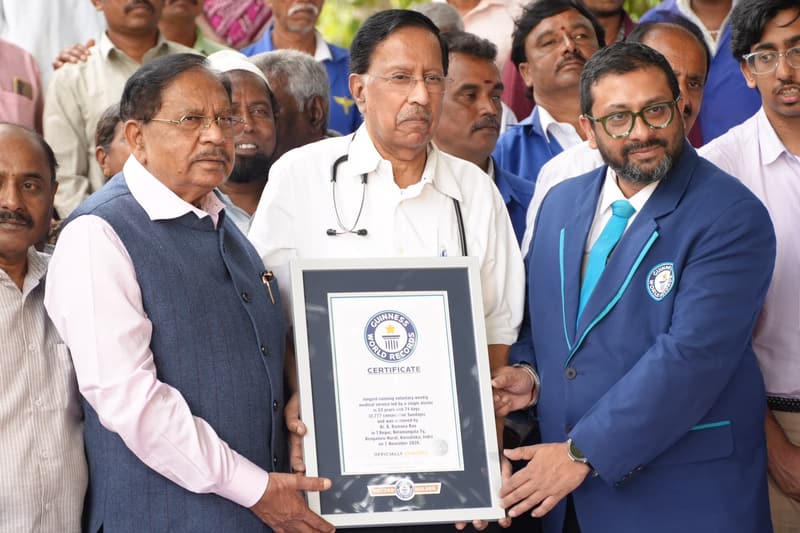
Padma Shri Dr B. Raman Rao enters Guinness World Records for treating over 33 lakh patients over 2777 Sundays
Rahul Gandhi calls for rethinking democracy and economic models amid growing influence of tech giants