Chennai Airport plans capacity boost to handle 3.5 crore passengers annually by April 2027
The Airports Authority of India (AAI) has drawn up a two-phase plan to increase passenger-handling capacity and aircraft movements at Chennai International Airport, following the Tamil Nadu government’s decision to scrap the proposed Parandur greenfield airport project.
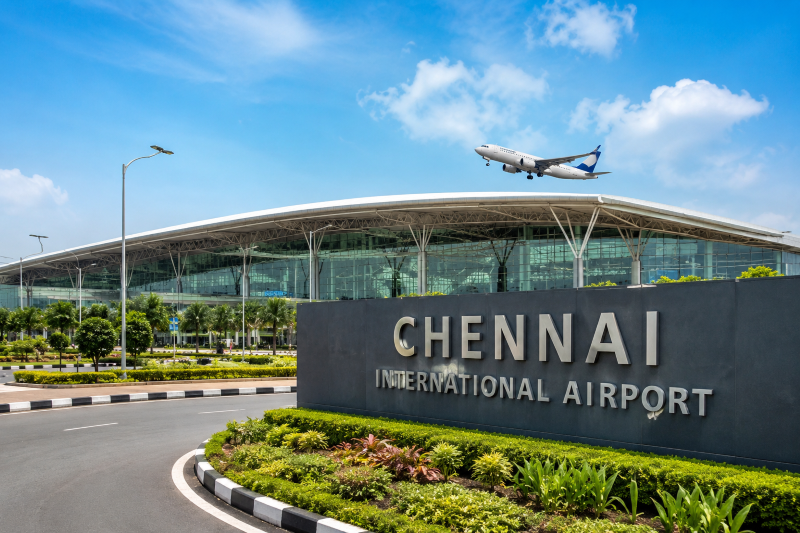
The optimisation plan aims to increase aircraft movements from the current 18 per hour to 36 in the first phase and eventually to 45 per hour. The strategy is intended to maximise the capacity of the existing airport while giving the state additional time to identify and develop a new greenfield airport.
Chennai airport currently handles around 2.3 crore passengers annually against its existing capacity of three crore. Under the proposed expansion, passenger-handling capacity is expected to rise to 3.5 crore a year by April 2027, with Terminal 1 handling one crore passengers, Terminals 2 and 3 together handling 1.6 crore, and Terminal 4 accommodating another 90 lakh passengers.
Improving aircraft movement on the runways is another priority. Seven rapid-exit taxiways on the main runway and three on the secondary runway are scheduled for completion by March 2028. These taxiways are designed to allow aircraft to leave runways faster after landing, helping reduce delays and increase operational efficiency.
The airport is also addressing constraints in aircraft parking and passenger boarding. Plans include increasing the number of aerobridges to 17 and providing 23 parking bays by April 2027. These improvements are expected to reduce dependence on remote parking stands, where passengers currently need buses to reach aircraft.
The second phase centres on a proposed fifth terminal, or T5, with capacity to handle two crore passengers annually. It is planned on existing airport land currently used for remote aircraft parking, avoiding the need for fresh land acquisition, according to the plan. The project, however, depends on improved road access, including an elevated corridor connecting it to National Highway 32 and the Outer Ring Road. A possible tunnel or other connection between T5 and the existing terminals is also under study.
Cargo operations are another focus area. The airport has taken over 19.06 acres of former Indian Airlines land to develop a truck-holding area with a token-based system, aimed at easing congestion along GST Road. Plans also include increasing cargo stands from nine to 14, with four designated for freighter aircraft.
The capacity-enhancement strategy comes as Chennai seeks to accommodate growing air travel demand despite constraints on airport land. The success of the plan will depend on completing terminal, runway, parking and road-connectivity works on schedule, while maintaining smooth operations at one of South India’s key international aviation hubs.
More from Tamil Nadu

Lakhs of devotees throng Tiruchendur for grand Soorasamharam festival; 4100 Police deployed

Tamil Nadu Governor Arlekar extends Kandha Sashti greetings, highlights spiritual significance of Soorasamharam

Annamalai slams Vijay Govt. over Thiruparankundram Deepam row; demands implementation of HC orders
More from Business

Shree Cement unveils ₹7,000 crore investment plans for three cement plants in Andhra Pradesh

Aster DM Quality Care invests ₹500 crore in 300-bed multispecialty hospital at Hyderabad’s Kondapur