From the MGR–NTR agreement to Vijay–Naidu talks: Tamil Nadu’s long quest for water security
Tamil Nadu Chief Minister C. Joseph Vijay’s scheduled meeting with Andhra Pradesh Chief Minister N. Chandrababu Naidu on October 13 brings renewed attention to a decades-old question: how can Chennai secure dependable drinking water, and how can Tamil Nadu strengthen water supplies to its drought-prone southern districts?
Two projects stand out in this context — the Telugu Ganga project, which was designed to bring Krishna water to Chennai, and the proposed Godavari–Cauvery river link, which could eventually provide an additional source of water for Tamil Nadu. Their histories illustrate both the potential of inter-state cooperation and the difficulties of translating water-sharing agreements into dependable supplies.
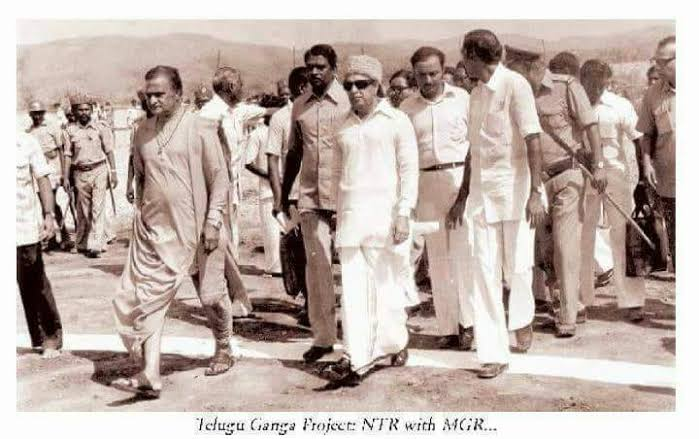
The history of Telugu Ganga dates back to February 15, 1976, when the Prime Minister announced a proposal in Chennai to share Krishna waters for the city’s drinking-water needs. The initiative subsequently took shape through an inter-state agreement signed on April 18, 1983, by the chief ministers of Andhra Pradesh and Tamil Nadu, N.T. Rama Rao and M.G. Ramachandran.
The project had a dual purpose: to provide drinking water to Chennai and to support irrigation in drought-prone parts of Andhra Pradesh. The original arrangement envisaged contributions of five thousand million cubic feet (TMC) each from Andhra Pradesh, Karnataka and Maharashtra, adding up to 15 TMC of Krishna water for Chennai. After accounting for transmission losses, the planned quantity to reach the Tamil Nadu border was 12 TMC. <Cite refs={["turn498672search4","turn498672search0","turn498672search23"]}/>
The water travels through a network of canals and balancing reservoirs, moving from the Srisailam system through Velugodu, Somasila and Kandaleru before reaching Tamil Nadu and the Poondi reservoir. From there, it can be distributed through Chennai’s reservoir and water-supply network.
The project was an important example of states attempting to address a major city’s water needs through cooperation across state boundaries. However, the existence of an agreement does not automatically guarantee that the full planned quantity will reach its destination every year. Releases, canal conditions, transmission losses and the availability of water all affect actual deliveries.
For Tamil Nadu, the immediate priority is therefore to seek a predictable release schedule, stronger coordination on canal maintenance and joint monitoring of the quantities released and received.
The idea of transferring water between river basins is older still. In 1980, the Centre formulated the National Perspective Plan to explore the transfer of water from basins considered to have surplus flows to regions facing water shortages. The Godavari–Cauvery proposal emerged as part of this broader vision for inter-basin water transfer. <Cite refs={["turn498672search5","turn498672search3"]}/>
The proposed chain comprises three principal links: Godavari–Krishna, Krishna–Pennar and Pennar–Cauvery. The National Water Development Agency prepared a draft Detailed Project Report for the combined links, which was circulated to the participating states in March 2019. The Centre has continued consultations with the states because water availability, allocations and the interests of basin states remain central to the proposal. <Cite refs={["turn498672search3","turn498672search1"]}/>
Tamil Nadu has sought a change to the final leg of the proposed route. Rather than terminating at the Grand Anicut, or Kallanai, the state has proposed a higher-level canal alignment that would cross the Palar and reach the Kattalai barrage at Mayanur in Karur district. The National Water Development Agency has examined the suggested alignment, but its technical and economic viability must be established before it can be taken forward. <Cite refs={["turn498672search3","turn498672search1"]}/>
The reason for Tamil Nadu’s request is practical: Mayanur is the starting point of the state’s Cauvery–Vaigai–Gundar link. Extending the national link to this location could connect the proposed inter-basin transfer more directly with the canal network intended to carry water towards drought-prone southern districts.
The quantity of water that might be transferred has changed across different versions of the proposal. In a 2021 parliamentary response, the Centre stated that the Phase-I proposal envisaged diverting 247 TMC from the Godavari system, but that only about 83 TMC could be planned to reach the Andhra Pradesh–Tamil Nadu border after accounting for requirements along the route in Telangana and Andhra Pradesh. Tamil Nadu had sought 200 TMC under the proposal. <Cite refs={["turn498672search3"]}/>
In December 2025, the Centre reported that an interim arrangement had been framed to transfer about 4,189 million cubic metres from the Godavari, alongside a proposal to supplement the Krishna basin through the Bedti–Varda link. These figures belong to different stages and configurations of planning; neither should be treated as a final, guaranteed allocation for Tamil Nadu. <Cite refs={["turn498672search1"]}/>
The final quantity will depend on the agreed project configuration, assessments of available water and the resolution of concerns raised by the participating states.
The Telugu Ganga project and the Godavari–Cauvery proposal operate on different timelines. The former is an existing water-transfer arrangement whose delivery performance matters immediately to Chennai. The latter is a major proposed infrastructure project that requires further inter-state consensus and technical and financial decisions.
In the immediate term, Tamil Nadu could seek a transparent schedule for Telugu Ganga releases, coordinated canal maintenance and regular sharing of data on water released and received.
On the longer-term proposal, discussions could focus on accelerating consultations among the states, resolving outstanding objections and advancing the feasibility assessment for the Mayanur alignment. Tamil Nadu could also press for clarity on the proposed allocation, funding arrangements and the process for finalising the project report.
The two projects should not be treated as substitutes. Better implementation of Telugu Ganga can help Chennai manage its drinking-water needs, while a viable Godavari–Cauvery–Vaigai–Gundar connection could potentially strengthen water security in other parts of Tamil Nadu.
From the 1976 announcement and the 1983 MGR–NTR agreement to the national river-linking proposals pursued over subsequent decades, the search for dependable water supplies has repeatedly required cooperation across political and state boundaries.
Vijay’s proposed talks with Naidu offer an opportunity to revisit that legacy with a focus on implementation. For Telugu Ganga, the test is whether agreed water can be delivered reliably. For the Godavari–Cauvery proposal, it is whether years of planning can lead to an agreed, technically viable and financially sustainable project.
Ultimately, Tamil Nadu needs more than announcements. It needs measurable commitments, transparent monitoring and a clear timetable for action — while ensuring that any new transfer respects the water needs and legitimate interests of all participating states.
More from Andhra Pradesh
Shree Cement unveils ₹7,000 crore investment plans for three cement plants in Andhra Pradesh
AP plans ₹25,000 crore space manufacturing ecosystem, secures major investments in rocket technology
Manchu Manoj named Andhra Yuva Sankalp 2K26 Ambassador; initiative reaches all 28 AP districts
More from Environment

NHAI begins survey for 43-km elevated corridor to Srisailam; night travel could become possible
Cyberabad Police plan one-way traffic loop to ease congestion in Hyderabad’s IT corridor near IKEA junction