Hyderabad Police alert banks, fintech and digital platforms against AI-assisted cyberattacks
Cyber advisory warns of attacks targeting financial infrastructure; Commissioner V.C. Sajjanar calls for stronger security across core and third-party systems
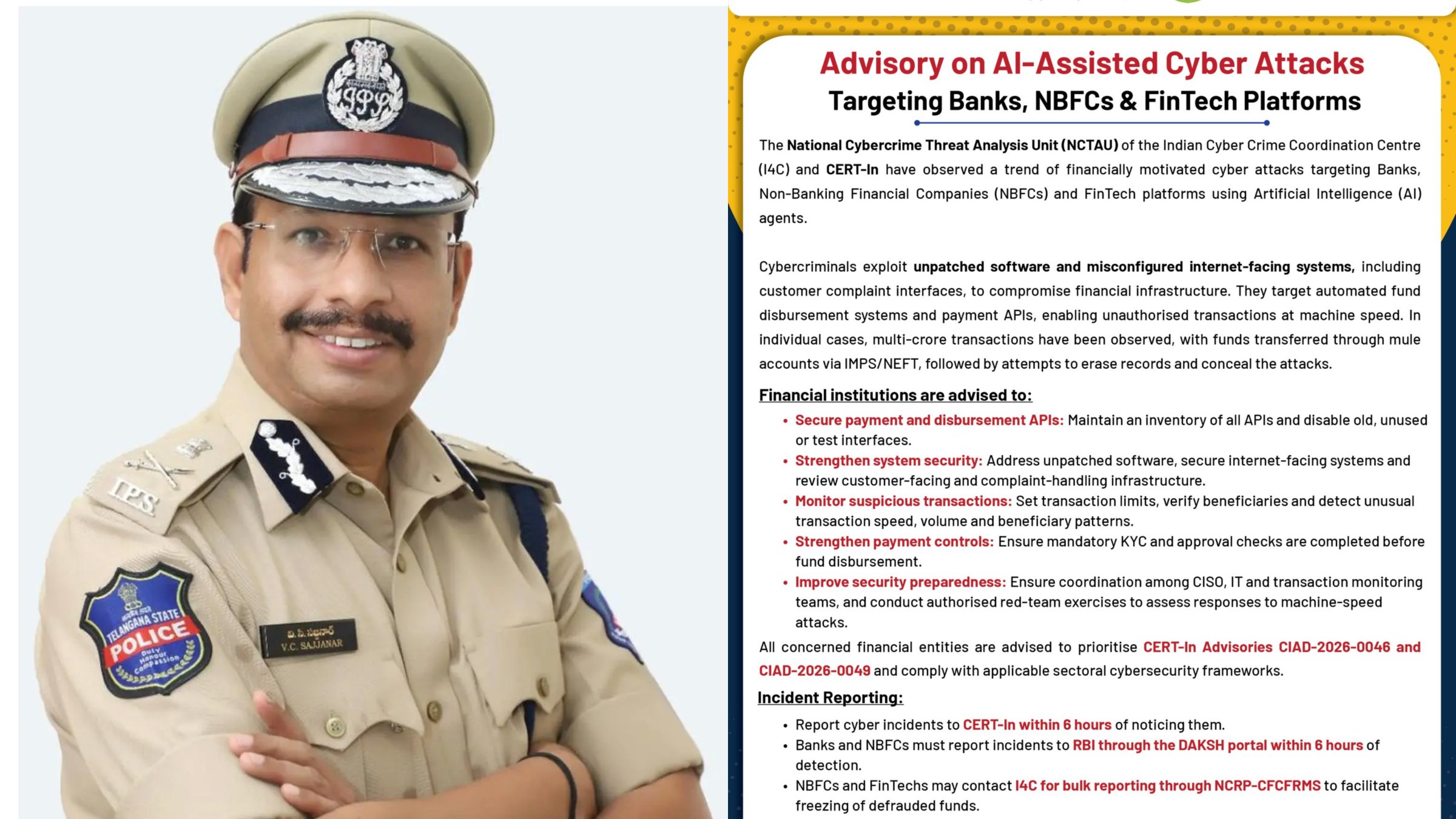
Hyderabad Police Commissioner V.C. Sajjanar has urged banks, financial institutions and digital service platforms to strengthen their cybersecurity infrastructure in view of an increasing number of complex cyber incidents involving artificial intelligence-assisted attacks and organised hacker syndicates.
In a public advisory, Sajjanar said entities handling citizens' finances and personal data, including banks, financial institutions, quick-commerce companies and mobility platforms, must strengthen their cybersecurity systems, operational processes and technical manpower to counter evolving threats.
He emphasised that third-party systems, services and software modules handling confidential information must be treated with the same level of security as an organisation's core applications. He called for stringent quality and security standards to be implemented across the entire technology ecosystem, pointing out that vulnerabilities in external systems could also compromise sensitive data and financial transactions.
The advisory issued by the National Cybercrime Threat Analysis Unit (NCTAU) of the Indian Cyber Crime Coordination Centre (I4C), in coordination with CERT-In, on November 3, has highlighted a growing trend of financially motivated cyberattacks targeting banks, Non-Banking Financial Companies (NBFCs) and fintech platforms through AI agents.
According to the advisory, cybercriminals are exploiting unpatched software and misconfigured internet-facing systems, including customer complaint interfaces, to gain access to financial infrastructure. They are targeting automated fund-disbursement systems and payment application programming interfaces (APIs), enabling unauthorised transactions at high speed.
The advisory has also reported cases involving multi-crore transactions, with money allegedly transferred through mule accounts using IMPS and NEFT channels. Attackers have subsequently attempted to erase records and conceal evidence of their activities.
Financial institutions have been advised to maintain an inventory of payment and disbursement APIs and disable outdated, unused or test interfaces. They have also been asked to address software vulnerabilities, secure internet-facing systems and strengthen customer-facing and complaint-handling infrastructure.
Other recommended measures include setting transaction limits, verifying beneficiaries, monitoring unusual transaction volumes and patterns, and ensuring mandatory KYC and approval checks before releasing funds. Institutions have also been advised to improve coordination among their Chief Information Security Officers, IT departments and transaction-monitoring teams, besides conducting authorised red-team exercises to assess their preparedness against high-speed attacks.
The advisory has called upon financial entities to prioritise CERT-In advisories CIAD-2026-0046 and CIAD-2026-0049 and comply with applicable sectoral cybersecurity frameworks.
It has also reiterated the importance of prompt incident reporting. Cyber incidents must be reported to CERT-In within six hours of detection. Banks and NBFCs are required to report incidents to the Reserve Bank of India through the DAKSH portal within the same period. NBFCs and fintech companies can also approach I4C for bulk reporting through the NCRP-CFCFRMS platform to facilitate the freezing of defrauded funds.
Sajjanar stressed that strengthening cybersecurity was essential not only to protect institutional systems but also to safeguard citizens' finances, personal information and overall well-being.
More from Telangana


More from Dakshin

Padma Shri Dr B. Raman Rao enters Guinness World Records for treating over 33 lakh patients over 2777 Sundays

Shree Cement unveils ₹7,000 crore investment plans for three cement plants in Andhra Pradesh