PVG Raju: Born a Maharaja, lived a Democrat, dedicated his legacy to the people
Remembering the last crowned Maharaja of Vizianagaram, who renounced royal privileges, embraced socialist ideals and devoted his wealth and public life to education, equality and social justice. Based on a commemorative article by Srinivas Ganjivarapu
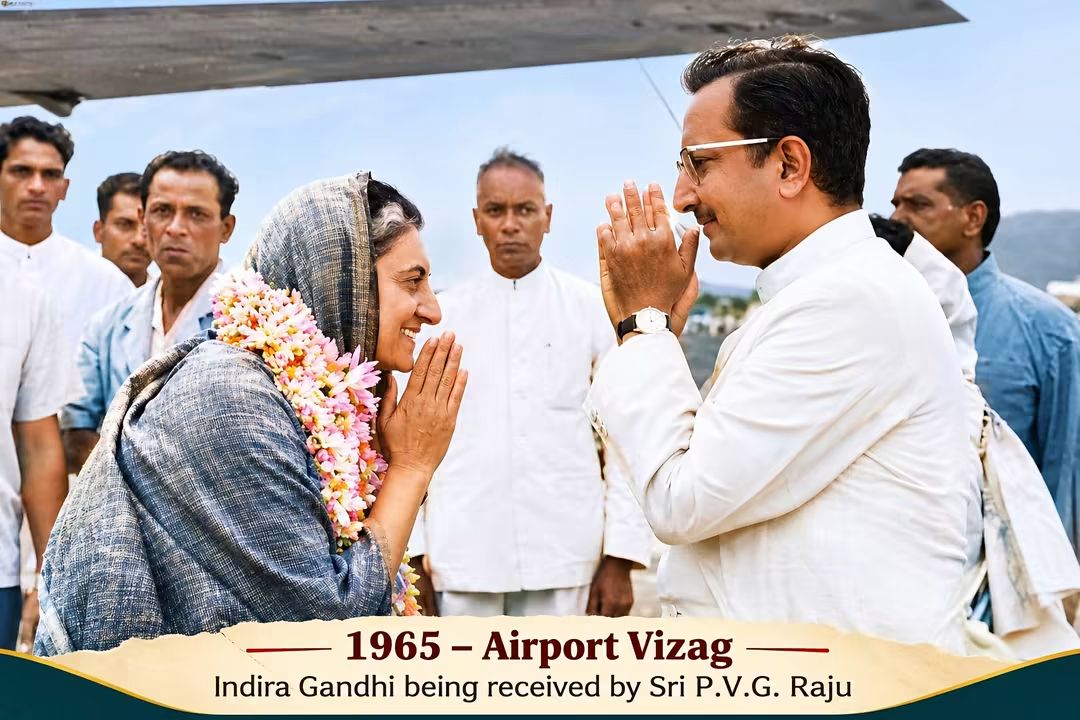
At a time when political power is increasingly associated with hereditary privilege, personal wealth and the concentration of authority within influential families, the life of Pusapati Vijayarama Gajapathi Raju, popularly known as PVG Raju, offers a remarkable lesson in democratic leadership. Born into one of the most distinguished royal families of southern India, he chose to relinquish the privileges of his birth, embrace socialist politics and dedicate much of his inherited wealth to education and public welfare.
PVG Raju, who died on November 14, 1995, at the age of 71, was an unusual figure in India's transition from princely and zamindari rule to parliamentary democracy. Rather than resist the erosion of hereditary authority, he accepted democratic change and built a political career around public service.
His journey from royal inheritance to democratic politics remains particularly relevant in contemporary India, where the persistence of political dynasties and feudal attitudes often raises questions about the true meaning of representative government.
A Royal Legacy Rooted in Education and Culture:
The Vizianagaram royal family's history stretches back several centuries, with the princely establishment traditionally traced to 1591. The imposing Vizianagaram Fort, constructed in 1713 by Vijayarama Raju, remains a reminder of the dynasty's historical influence.
Following the Battle of Padmanabham in 1794, the estate came under the Madras Presidency's zamindari system. Nevertheless, successive rulers continued to patronise education, literature, music and the arts.
Maharaja Vijayarama Gajapathi Raju III contributed to the development of educational institutions, including Maharajah's College, while Ananda Gajapathi Raju supported literary figures such as Gurajada Apparao. Their patronage helped shape the cultural and intellectual development of northern Andhra.
It was into this family that PVG Raju was born in May 1924, to Alak Narayana Gajapathi Raju and Vidyavati Devi.
His father, remembered for his progressive outlook and association with the Justice Party, exercised a significant influence on his political thinking. According to biographical accounts, attempts by British authorities to separate the young prince from his father left a lasting impression on him, contributing to his lifelong opposition to arbitrary authority.
From Vizianagaram to Columbia University:
PVG Raju received his early education in Visakhapatnam and completed his intermediate studies in Bengaluru, where he also distinguished himself in tennis.
He subsequently travelled to the United States to pursue higher education at Columbia University.
Despite his privileged background, he reportedly worked part-time in restaurants and cafeterias, seeking firsthand experience of ordinary working life. This exposure to a society beyond hereditary privilege helped broaden his understanding of economic inequality, individual dignity and democratic citizenship.
His intellectual interests extended beyond politics. Accounts of his university years refer to his attendance at a lecture by Albert Einstein, which strengthened his interest in scientific thought.
During his time in the United States, he met Kusum Madgavkar, a relative of the distinguished mathematician and historian D. D. Kosambi. They married in 1949 and returned to India.
The Maharaja Who Renounced His Privileges:
On August 24, 1945, PVG Raju was crowned the last Maharaja of Vizianagaram. However, his approach to hereditary power differed sharply from that of many traditional rulers.
He supported the abolition of the zamindari system and, according to accounts of his life, expressed his willingness to relinquish estate privileges without demanding compensation.
At a time when land reforms and the abolition of hereditary estates generated considerable resistance among landed elites, his position represented an important departure from established aristocratic interests.
With the integration of princely territories and the restructuring of landownership following Independence, PVG Raju increasingly identified himself with democratic politics rather than inherited authority.
Accounts also describe his willingness to surrender valuable family possessions during the broader process of dismantling royal privileges.
His decisions reflected a fundamental conviction: political legitimacy should arise from the consent and welfare of the people, not from birth, title or inherited wealth.
A Socialist Who Fought for Farmers and the Displaced:
Inspired by Jayaprakash Narayan and Dr. Ram Manohar Lohia, PVG Raju became associated with the socialist movement and entered active politics.
His political commitments were not confined to legislative debates or electoral campaigns. He participated in movements concerning agricultural rights, land reforms and the rehabilitation of displaced communities.
His involvement reportedly included the Karivena inam satyagraha in Kurnool district, protests concerning families displaced by the Nagarjuna Sagar project, and farmers' movements in Bihar. These struggles also led to periods of imprisonment.
Between 1952 and 1980, he contested nine elections and won all nine, serving five terms as a member of the Legislative Assembly and four as a member of Parliament.
He also held ministerial responsibilities in education and health, contributing to policies intended to strengthen educational institutions and improve access to public services.
His work in education included support for grant-in-aid arrangements for private colleges and the implementation of University Grants Commission pay scales.
For someone born into hereditary power, his repeated electoral victories represented a different form of public legitimacy: the authority conferred by voters.
PVG Raju's most enduring legacy was his conviction that education could transform society and reduce the inequalities inherited from centuries of social and economic hierarchy.
On November 12, 1958, he established the Maharaja Alak Narayan Society of Arts and Science, popularly known as MANSAS, in memory of his father.
The scale of his philanthropy was extraordinary. According to the Andhra Pradesh High Court's account of the trust's establishment, PVG Raju donated approximately 14,186 acres of land across several districts to MANSAS. His brother, Visweswara Gajapathi Raju, also contributed substantial properties.
The trust became an important institution for advancing education, particularly in northern Andhra Pradesh. Its educational network includes schools and colleges offering courses in arts, sciences, engineering, pharmacy, law and management.
Among his notable contributions was the dedication of royal properties to educational purposes, including the historic Vizianagaram Fort complex. The Moti Mahal building was made available for women's education, reflecting his commitment to expanding educational opportunities beyond traditional social boundaries.
His philanthropy also extended to Korukonda Sainik School. PVG Raju played a central role in making the Korukonda Palace and surrounding land available for the establishment of the institution in the early 1960s. The school itself acknowledges his role in facilitating this important contribution to military education.
He also supported Andhra University, donated properties for educational development and served as its Pro-Chancellor.
For PVG Raju, education was not merely an instrument of individual advancement. It was a means of creating a more equal society in which opportunities would be determined by ability and effort rather than hereditary status.
A Near-Fatal Accident and an Extraordinary Recovery:
One of the most dramatic episodes of PVG Raju's life occurred on May 11, 1964, when he was involved in a serious road accident while travelling in Punjab.
According to the biographical account, a tyre burst caused his vehicle to overturn, leaving him with severe injuries. He reportedly remained in a coma for 79 days at a hospital in Chandigarh.
He subsequently underwent specialised treatment in Germany and England before gradually recovering.
The accident significantly affected his physical health and interrupted what had been a promising political career. Nevertheless, he demonstrated considerable determination by returning to public life and continuing his political activities for many years.
His recovery became another defining chapter in a life characterised by personal resilience, intellectual curiosity and a strong sense of public duty.
From Public Office to Spiritual Reflection:
After decades in politics, PVG Raju withdrew from active political life in 1983 and increasingly devoted himself to spiritual pursuits.
He spent his later years near the Sri Varaha Lakshmi Narasimha Swamy Temple at Simhachalam, where he embraced a relatively simple lifestyle, far removed from the ceremonial grandeur associated with his royal ancestry.
Influenced by Swami Jnanananda, he studied Poorna Yoga and explored the relationship between scientific reasoning, philosophy and spirituality.
His interest in spiritual life was consistent with his broader intellectual outlook. He sought to reconcile scientific inquiry with philosophical reflection rather than regard them as opposing traditions.
PVG Raju died on November 14, 1995, leaving behind a legacy that extended well beyond electoral politics.
A Family Legacy That Continues in Public Life:
PVG Raju's association with public service continued through subsequent generations of the Pusapati family.
His eldest son, Pusapati Ananda Gajapathi Raju, served in public life and subsequently headed MANSAS until his death in 2016.
His younger son, Pusapati Ashok Gajapathi Raju, established a long political career, serving as a legislator, parliamentarian and Union Minister for Civil Aviation. He also held responsibilities associated with the family's educational and charitable institutions.
The family's political legacy has extended into another generation through Aditi Vijayalakshmi Gajapathi Raju, who represents Vizianagaram in the Andhra Pradesh Legislative Assembly.
However, PVG Raju's enduring significance rests not simply in the continuation of a prominent family name, but in the institutions and public assets he helped place at society's disposal.
A Democratic Lesson for Today's Political Leadership:
The most compelling aspect of PVG Raju's life is the contrast between the privileges he inherited and the democratic principles he chose to uphold.
He was born into a system in which authority flowed from ancestry. Yet he embraced a political order in which public representatives were expected to derive their legitimacy from the people.
He possessed vast inherited wealth, but directed substantial resources towards education and charitable institutions. He enjoyed royal status, yet participated in socialist movements advocating the rights of farmers, ordinary citizens and disadvantaged communities.
His life also raises an uncomfortable question about contemporary Indian politics. While democratic India formally abolished hereditary political authority and dismantled the zamindari system, elements of feudal political culture continue to survive. In some political families, electoral victories are treated almost as hereditary entitlements, public office becomes closely associated with personal privilege, and political influence is passed from one generation to another.
The contradiction is striking. PVG Raju was born a hereditary ruler but consciously embraced democratic values. Some contemporary politicians, despite obtaining authority through democratic elections, appear increasingly comfortable with the symbols and practices of hereditary power.
His example demonstrates that democracy requires more than elections, political parties and constitutional institutions. It also demands humility, accountability, respect for citizens and a willingness to place public interest above personal privilege.
PVG Raju's contributions to education, his association with socialist politics and his renunciation of inherited advantages offer an alternative understanding of leadership.
He demonstrated that wealth could be used to create educational opportunities, political influence could serve social reform, and inherited authority could be voluntarily surrendered in favour of democratic citizenship.
More than three decades after his death, his life remains an important chapter in the political and social history of Andhra Pradesh.
PVG Raju was born into royalty, but his lasting greatness came from what he gave away, not what he inherited. His legacy is a reminder that the true measure of leadership lies not in the power one possesses, but in the opportunities one creates for others.
More from Andhra Pradesh
Shree Cement unveils ₹7,000 crore investment plans for three cement plants in Andhra Pradesh

AP plans ₹25,000 crore space manufacturing ecosystem, secures major investments in rocket technology