South Indian women lead India's banking savings chart; all five states above national average
Keralam tops at 47%, Andhra Pradesh follows at 46%; Tamil Nadu, Telangana and Karnataka also outperform National Average
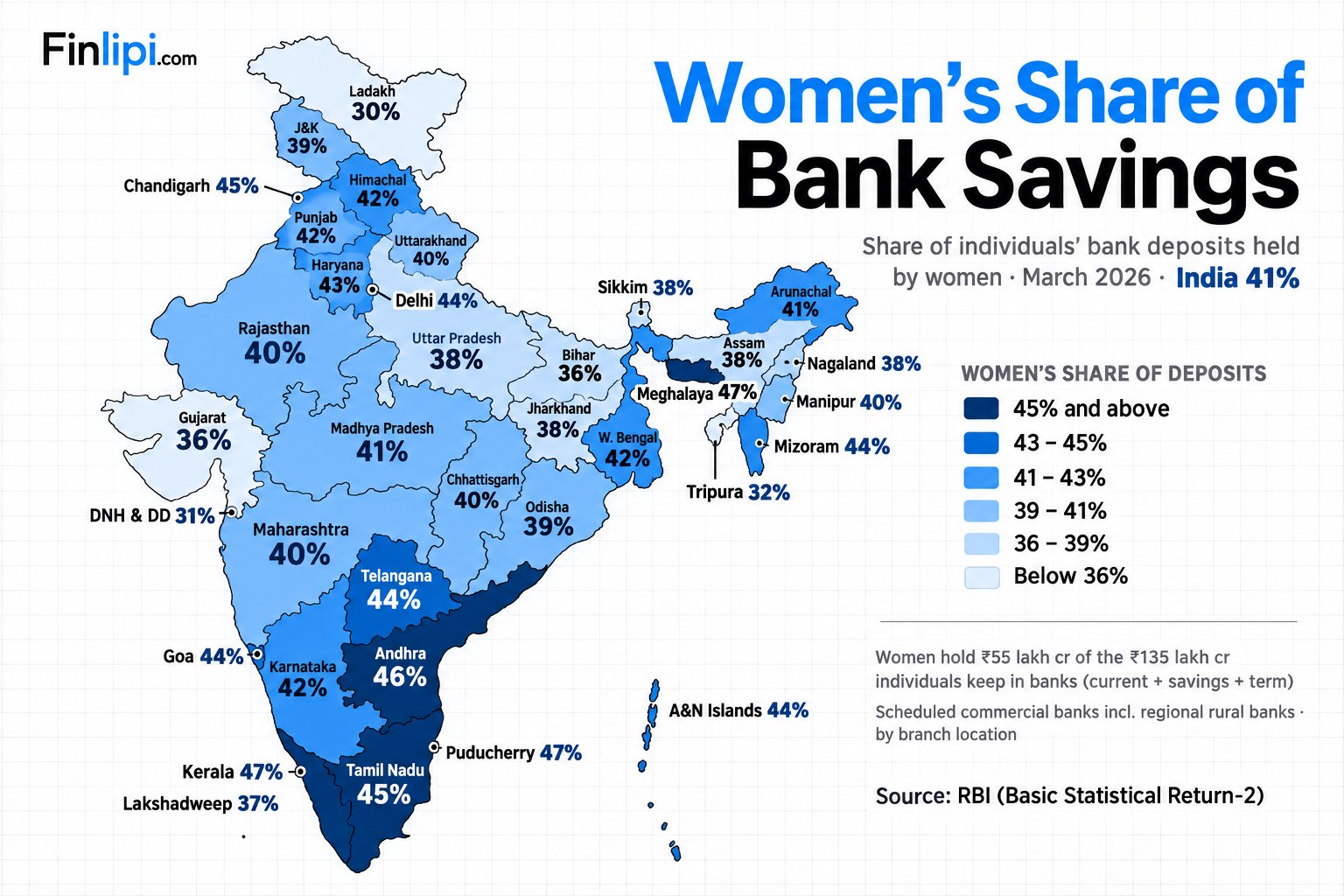
Women across South India have emerged as significant contributors to the country's banking savings, with all five southern states recording a higher share of individual bank deposits held by women than the national average of 41%, according to Reserve Bank of India (RBI) data for March 2026.
Keralam leads the southern states with women accounting for 47% of individual bank deposits, followed closely by Andhra Pradesh at 46%. Tamil Nadu stands at 45%, Telangana at 44% and Karnataka at 42%, highlighting the strong representation of women in the formal banking system across the region.
The figures, presented in an analysis by Finlipi.com based on RBI's Basic Statistical Return-2, place Keralam alongside Meghalaya and the Union Territory of Puducherry at the top of the national rankings, with each recording a 47% share. Andhra Pradesh follows at 46%, just one percentage point behind the leaders.
Tamil Nadu's 45% share places it four percentage points above the national average, while Telangana exceeds the national benchmark by three percentage points. Karnataka, at 42%, also remains ahead of the national figure.
The data reveals a particularly interesting pattern in southern India, where every state has crossed the national average, reflecting women's substantial presence in formal banking and savings.
At the national level, women hold approximately ₹55 lakh crore of the ₹135 lakh crore deposited by individuals in scheduled commercial banks, including regional rural banks. These deposits include savings accounts, current accounts and term deposits.
The southern states' performance is significant given their diverse economic structures. Keralam has a strong remittance-linked economy, Tamil Nadu and Karnataka have major industrial and services sectors, Telangana has a rapidly expanding technology-driven economy, while Andhra Pradesh has a substantial agricultural and rural economic base.
Despite these differences, women in all five states account for more than 40% of individual bank deposits, indicating a broadly consistent pattern of participation in formal savings.
Puducherry, which is geographically and economically closely connected with Tamil Nadu, also features prominently with a 47% share, matching the highest recorded percentage in the country.
The figures, however, measure the proportion of bank deposits held in women's names rather than the percentage of women who maintain bank accounts. They also do not independently establish women's financial autonomy, income levels or control over household finances.
Nevertheless, the RBI data offers an encouraging picture of women's participation in the banking system across southern India. Greater access to financial services, savings instruments, employment opportunities and financial literacy could further strengthen women's economic position.
With Keralam, Andhra Pradesh, Tamil Nadu, Telangana and Karnataka all outperforming the national average, South India stands out as a region where women command a comparatively larger share of individual bank savings, reinforcing the importance of women's participation in the country's financial landscape.
More from Telangana

More from Business
IndiGo plans major December expansion at Hyderabad Airport, targets 1,300 weekly departures

Bengaluru startups raise $85 billion, account for 47% of India’s venture funding: Innovation Report 2026