Free Press is not a favour from those in power; it is the Right of every citizen
On National Press Day, let's remember that journalism's highest duty is not to please the powerful, but to question them. - Palwai Raghavendra Reddy Former Journalist, Political Commentator and Author
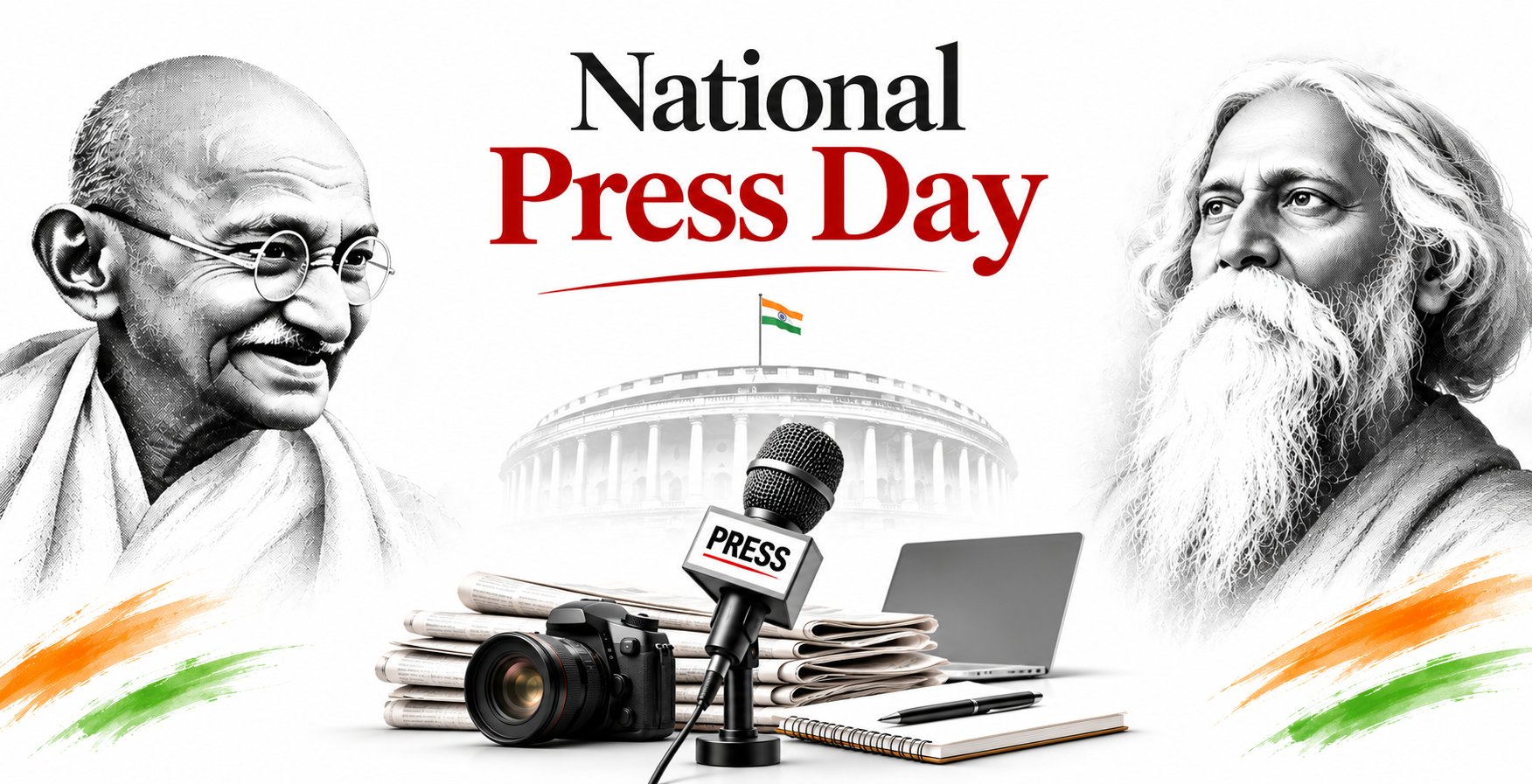
“Freedom of the press is a precious privilege that no country can forego,” observed Mahatma Gandhi. Nearly eight decades after Independence, these words remain profoundly relevant to India, a nation whose democratic strength depends not merely on elections and institutions, but also on the freedom of its citizens to question authority, challenge injustice and demand accountability.
Rabindranath Tagore's immortal vision of a nation “Where the mind is without fear and the head is held high” offers an equally powerful reminder of what genuine freedom means. His aspiration for a society where knowledge is free, reason prevails and words emerge from the depths of truth is, in many ways, the very foundation upon which independent journalism must stand.
As India observes National Press Day on November 16, the occasion demands more than ceremonial greetings, awards and speeches celebrating the Fourth Estate. It calls for serious introspection about the state of journalism, the pressures confronting media institutions and the growing distance between the ideals of a free press and the realities of contemporary newsrooms.
The fundamental responsibility of journalism is to hold power accountable, not to become an instrument through which power manufactures public consent. Governments, irrespective of their political affiliations, naturally seek favourable publicity. But the media's responsibility is not to reproduce official narratives unquestioningly. It must examine government claims, expose administrative failures, investigate corruption and provide citizens with information that enables independent judgment.
Unfortunately, sections of India's media increasingly appear more comfortable interrogating the Opposition than scrutinising those exercising executive authority. Political debates are frequently reduced to spectacles of accusation and confrontation, while questions concerning unemployment, inflation, inequality, public healthcare, education and institutional accountability struggle to receive sustained attention.
Equally disturbing is the growing influence of corporate ownership, advertising dependence and political proximity over editorial decisions. When commercial interests begin determining what constitutes news, journalism risks surrendering its independence. A newspaper or television channel may remain financially successful while gradually losing the public trust that gives journalism its democratic legitimacy.
The emergence of digital media has introduced another profound challenge. Social media platforms have democratised access to information, enabling independent journalists and smaller publications to challenge established narratives. Yet the same technological revolution has accelerated misinformation, sensationalism, manipulated content and the circulation of unverified allegations.
In this environment, credibility must become journalism's most valuable currency. Speed cannot replace accuracy, opinion cannot masquerade as reporting, and political preference cannot justify selective presentation of facts. The principles of verification, fairness, transparency and accountability must remain non-negotiable, regardless of whether journalism is practised through newspapers, television channels or digital platforms.
Press freedom, however, cannot survive through professional ethics alone. Journalists must be able to investigate and report without intimidation, arbitrary legal harassment, economic retaliation or threats to their personal safety. Equally, media organisations must protect the editorial independence of their journalists rather than compromise it for political access or commercial advantage.
A genuinely independent press must question every government with equal courage. It cannot become fearless when one political party governs and submissive when another assumes office. Journalism that changes its standards according to the identity of those in power ceases to serve democracy and begins serving political convenience.
National Press Day should therefore renew our collective commitment to journalism that speaks for ordinary citizens, particularly those whose voices rarely reach the corridors of power.
The media must never become the government's public relations department, just as it must never become the unquestioning mouthpiece of any Opposition party. Its allegiance must remain exclusively with truth, constitutional values and the public interest.
Democracy does not become stronger when uncomfortable questions disappear. It becomes stronger when those questions can be asked openly, answered honestly and debated without fear. The true measure of press freedom is not how loudly journalists praise those in power, but how freely they can challenge them.
On this National Press Day, let us remember that a free press is not a concession granted by governments. It is an essential democratic right belonging to the people. For when the press loses its courage, democracy begins to lose its voice.
More from Beyond Dakshin

Rashmika Mandanna reveals intense preparation behind her transformation for ‘Mysaa’