Three Army Engineers deputed to Telangana for SLBC, Kaleshwaram works
The Telangana government is strengthening its technical capacity for two major irrigation assignments by bringing in three officers from the Indian Army’s Corps of Engineers to work on the Srisailam Left Bank Canal (SLBC) tunnel and the rehabilitation of the Medigadda, Annaram and Sundilla barrages.
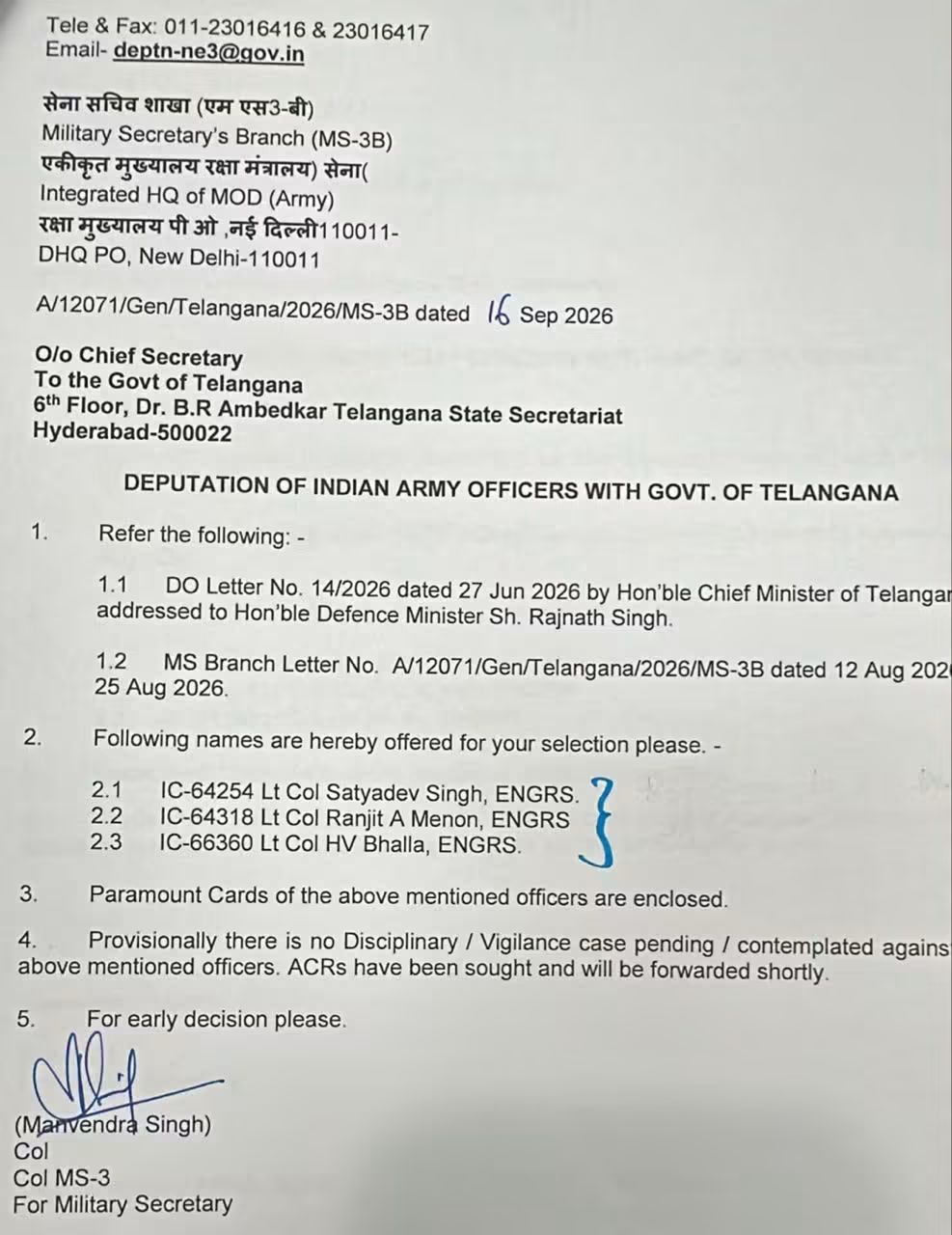
Lt Col Satyadev Singh, Lt Col Ranjit A. Menon and Lt Col H. V. Bhalla have been deputed to the Telangana government service and will be deployed with the Irrigation Department. One of the officers will supervise operations at the two excavation fronts of the SLBC tunnel, including activities inside the tunnel, while the other two will work on the rehabilitation of the three Kaleshwaram barrages.
The move follows Telangana Chief Minister A. Revanth Reddy’s representation to Defence Minister Rajnath Singh on June 27 seeking specialised military engineering support. Irrigation Minister N. Uttam Kumar Reddy subsequently met Army Chief General Dhiraj Seth in New Delhi and requested the deputation of experienced Army engineers.
Uttam Kumar Reddy and General Dhiraj Seth are both alumni of the National Defence Academy at Khadakwasla. General Seth took charge as the 31st Chief of the Army Staff on June 30, 2026.
The Telangana government has also cited its experience with Col. Parikshit Mehra, a tunnelling expert who has been working with the State on deputation. Mehra has been involved with the SLBC tunnel and planning for the rehabilitation of the Kaleshwaram barrages.
Around 35 km of the approximately 44-km SLBC tunnel has been completed, with the State targeting completion of the remaining work by June 2028. Meanwhile, investigations into the Medigadda, Annaram and Sundilla barrages are nearing completion, with IIT Bombay and AFRY India examining the findings and preparing designs for structural interventions.
Uttam Kumar Reddy said the involvement of Army engineers would strengthen quality control, field coordination and accountability, while stressing that execution speed would not come at the expense of worker safety, engineering standards or long-term structural stability.